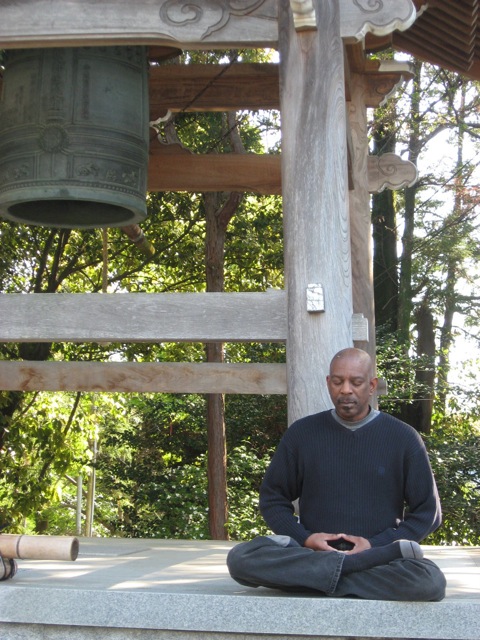
The practice here does not fit neatly into one lineage, one school, or one tradition — and that is not an apology. It is a description. Over decades of sitting, training, ordination, and simply living in Japan, the practice has grown toward what is actually present rather than what fits a category. What is present is vast.
Zen — Linji Chan
The Shifu was ordained in July 2016 in the Lin Chi (Rinzai) lineage of the Hsu Yun tradition through the Lohan Buddhist Temple order. His Dharma name is Fa Chuan Shakya. The Lin Chi school — known in Japan as Rinzai — is characterized by a directness and spontaneity that tends to resist systematization. The teacher strikes, the student responds, something opens or it does not.
The Shifu's personal practice leans toward Linji Chan spontaneity and integration into daily life. He does not center koan introspection as a primary path, preferring direct experience and embodied practice. Kung Fu, Kyudo, shakuhachi — these are not supplements to the meditation. They are the meditation, practiced with the same quality of attention as sitting.
The form is not the practice. The practice is what is alive inside the form. Once you see that, the form becomes a gift rather than a cage.
He has studied under Shifu Wu Chueh Miao-Tien of Heart Chan (Taiwan), Guohan William Tsao in the lineage of Sheng Yen and Dharma Drum Mountain, and serves as an associate priest at Komyoji Jodo-shu temple in Amagasaki. He is also a registered member of the Cosmos Chan/Zen Community and founder of the Osaka Lohan Chan Hermitage and Charities.

Jodo-Shu — Pure Land
Pure Land practice sits in an interesting place alongside Chan. On the surface they appear to be in tension — one emphasizes the power of one's own practice and direct realization, the other emphasizes faith and the compassionate working of Amitabha Buddha. In practice, at least in the Shifu's daily life, they are less contradictory than complementary. The nembutsu is not an escape from practice. It is practice — repeated, embodied, until the distinction between self-power and other-power stops making the noise it once did.
The Shifu serves as associate priest at Komyoji Jodo-shu temple in Amagasaki, participating in regular ceremonies and practice. Jodo-shu is one of the oldest Pure Land schools in Japan, founded by Honen in the 12th century. The simplicity of its central practice — the nembutsu, Namu Amida Butsu — carries a depth that rewards a lifetime of attention.
In Chinese Buddhism, Zen (Chan) and Pure Land were often practiced together rather than as separate paths as in Japan. This integration is clearly seen in the tradition of Xuyun (Master "Empty Cloud"), who emphasized both meditative insight and devotional recitation. Practitioners might engage in silent sitting to realize the nature of mind while also reciting the name of Amitabha Buddha to cultivate faith, focus, and continuity of awareness. For Xuyun, these were not contradictory methods but complementary: Chan clarified one's true nature in the present moment, while Pure Land practice supported stability, humility, and aspiration. Together, they formed a balanced path of direct realization and accessible practice suited to both monastic and lay life.
光明寺浄土宗(尼崎)の准住職として、定期的な儀式と修行に参加しています。
Theravada — The Forest Monk Tradition
The Shifu has practiced within the Theravada tradition in Thailand and particularly resonates with the Forest Monk tradition philosophy. Where some schools of Buddhism build elaborate institutional forms, the Forest Monks tend to strip things down to what is essential — the robe, the bowl, the forest, the practice. There is something in that aesthetic of simplicity that runs through everything else in the Shifu's life, from the hermitage itself to the choice of a shakuhachi over a concert hall.
The path here integrates elements of Chan/Zen, Pure Land, and touches of Theravada — not as a compromise between them, but as an honest account of what has actually been encountered and found useful over a lifetime of practice.
Osaka Lohan Chan Hermitage
The Shifu is the founder of Osaka Lohan Chan Hermitage and Charities, a small contemplative space rooted in the Lohan Buddhist Temple order. The hermitage name honors the late Abbot who founded the order — a teacher who deliberately chose Lohan over Shaolin for reasons of spirit over spectacle, a choice the hermitage continues to reflect.