The Komusō were a loosely organized order of wandering Zen monks who used the shakuhachi — the end-blown bamboo flute — as their primary spiritual practice rather than sitting meditation. They are most recognizable by the tengai, the deep woven basket worn over the head, which served the dual purpose of anonymity and focus: the monk could not be seen, could not perform for an audience, could only play.
The Shifu is registered as a Komusō at Myoanji temple in Kyoto, one of the historical centers of Komusō practice in Japan and the home of the Fuke school of shakuhachi. His motivation for walking this path was practical and clear — to engage in visible public practice and service without being limited by language barriers. The shakuhachi transcends language. In Japan, a man in robes carrying a bamboo flute needs no translation.
Suizen — Blowing Meditation
Suizen is the practice of using the shakuhachi as a form of seated or standing meditation — literally, "blowing Zen." Unlike performance or musical study, suizen is not oriented toward technique for its own sake. The sound that emerges from the flute is understood as an expression of the player's inner state. A wavering note is not a mistake to be corrected; it is information. Still, in today's modern world many consider the shakuhachi a Zen tool, not a musical instrument.
The traditional honkyoku repertoire — the solo pieces of the Fuke school — were composed specifically for this purpose. They are not songs. They are practices. Each one carries a different quality of attention, a different quality of space.
The Shifu sees the connection between suizen, Kyudo, and Chan as essentially the same movement — from form, through balance, to emptiness. The breath connects them all. The shakuhachi simply makes that breath audible.
Takuhatsu — Walking Alms
Takuhatsu is the traditional Buddhist practice of walking alms — the monk moves through the streets, receiving offerings, offering presence. For a Komusō, the offering is sound. The shakuhachi is played while walking, the tengai worn, the monk visible without being seen.
The Shifu engages in shakuhachi takuhatsu as his form of musical ministry — a way of being present in public life as a practitioner without requiring spoken communication or institutional backing. He has played at ceremonies at Komyoji Jodo-shu temple in Amagasaki and has visited Icchokenji in Fukuoka several times, sitting Zazen and playing with the Abbot there.
Recordings from Takuhatsu Practice
Two pieces from the honkyoku repertoire — played as suizen, offered here as they were played in the streets: without introduction, without performance.
Choshi Yamamoto
Anjikan
If you are moved by this music and wish to offer something in return, any donation — however small — is gratefully received. Offerings go to the charity causes supported by Lohan Charities. Send to PayPal: shifu@osakalohanhermitage.org — or visit the Charities page to learn more.
虚無僧として尺八の托鉢を行い、修行者としての公の場での実践と奉仕に取り組んでいます。尼崎の光明寺浄土宗での儀式での演奏や、福岡の一徹源寺での座禅と演奏も行っています。
The Instrument
The Shifu's current shakuhachi teacher is 上村風穴, known for his unique sound and depth, and founder of the Uemura-ryu system. He is a member of Koten-Shakuhachi-Kenkyuu-Kai (古典尺八研究会 — Society for the Study of Classical Shakuhachi), founded by Sakurai Muteki, which focuses on the 2.5-shaku Jinashi shakuhachi — the traditional unlined bamboo flute that predates the more refined modern instrument. His first shakuhachi teacher was 貴志清, a Kinko-ryu stylist.
The Jinashi shakuhachi is deliberately imperfect. Its natural nodes and irregularities mean each instrument has its own voice, its own tendencies, its own resistances. Working with that rather than against it is itself a teaching.
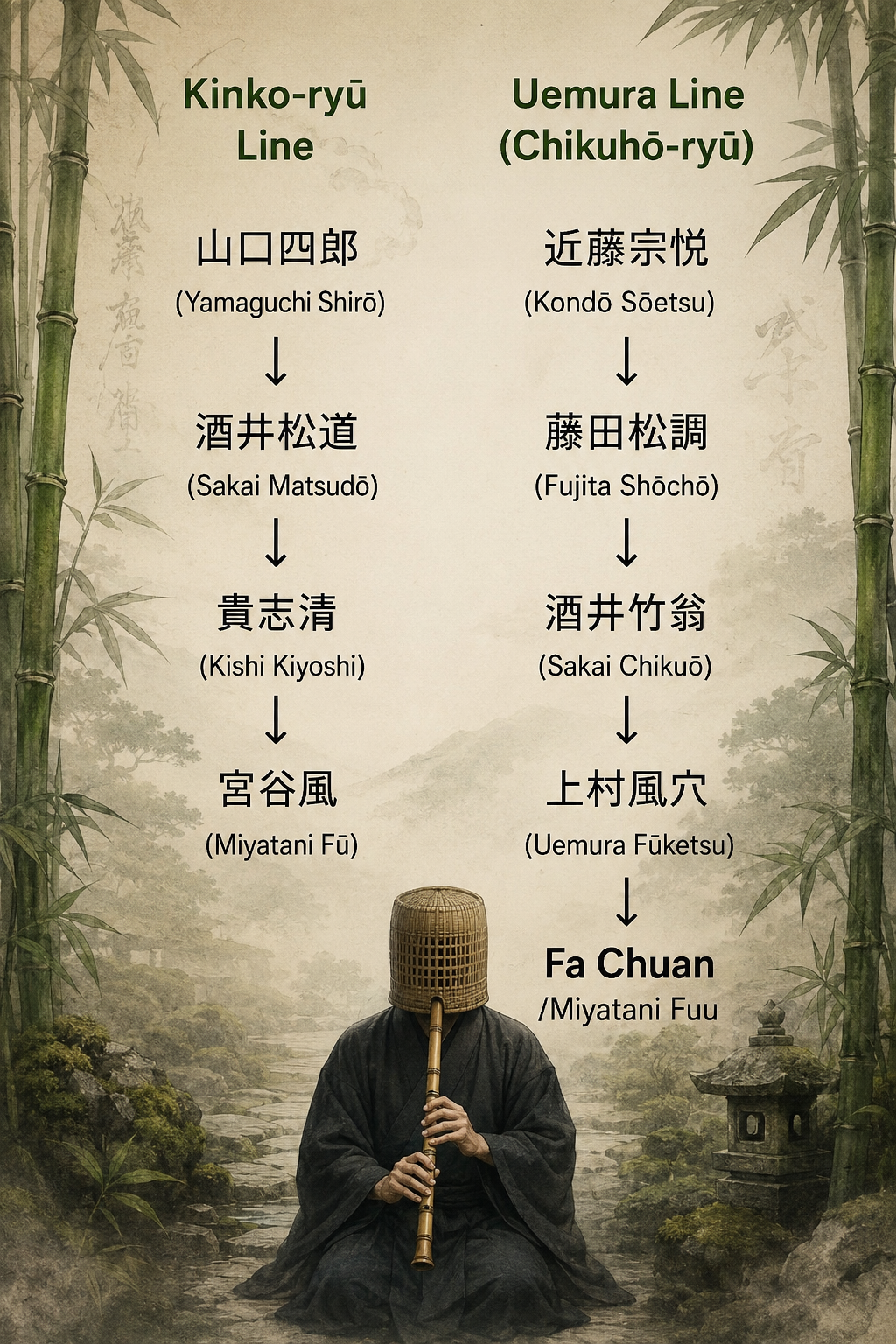
Shakuhachi Lineage
On Sound and Unseen Influence
The Shifu sees parallels between his Qigong and energetic healing studies and his takuhatsu practice — both involve an unseen influence that moves through a field wider than the practitioner alone. Whether one frames this theologically, energetically, or simply as the observable effect of sincere practice in a public space, the experience reported by those present tends to be similar: something settles.
He is also a multi-instrumentalist, playing piano, bass, guitar, shamisen, and harmonica alongside the shakuhachi. Music, like the martial and contemplative practices, is understood here as a form of embodied presence rather than performance.
現在の師匠:上村風穴先生。古典尺八研究会(桜井無笛先生創立)メンバー。主に2尺5寸の地無し管を演奏。初代師匠:貴志清先生。